Washington State Pension Fund Invests Rs 230 Cr to Revive Stalled Greater Noida Project: What It Means for Homebuyers
WSIB's Rs 230 crore investment in Hawelia Group's Shri Radha Sky Gardens marks the first foreign pension fund entry into India's stalled project revival market. Analysis, context, and what it signals for NCR homebuyers.
The Headline Everyone Missed
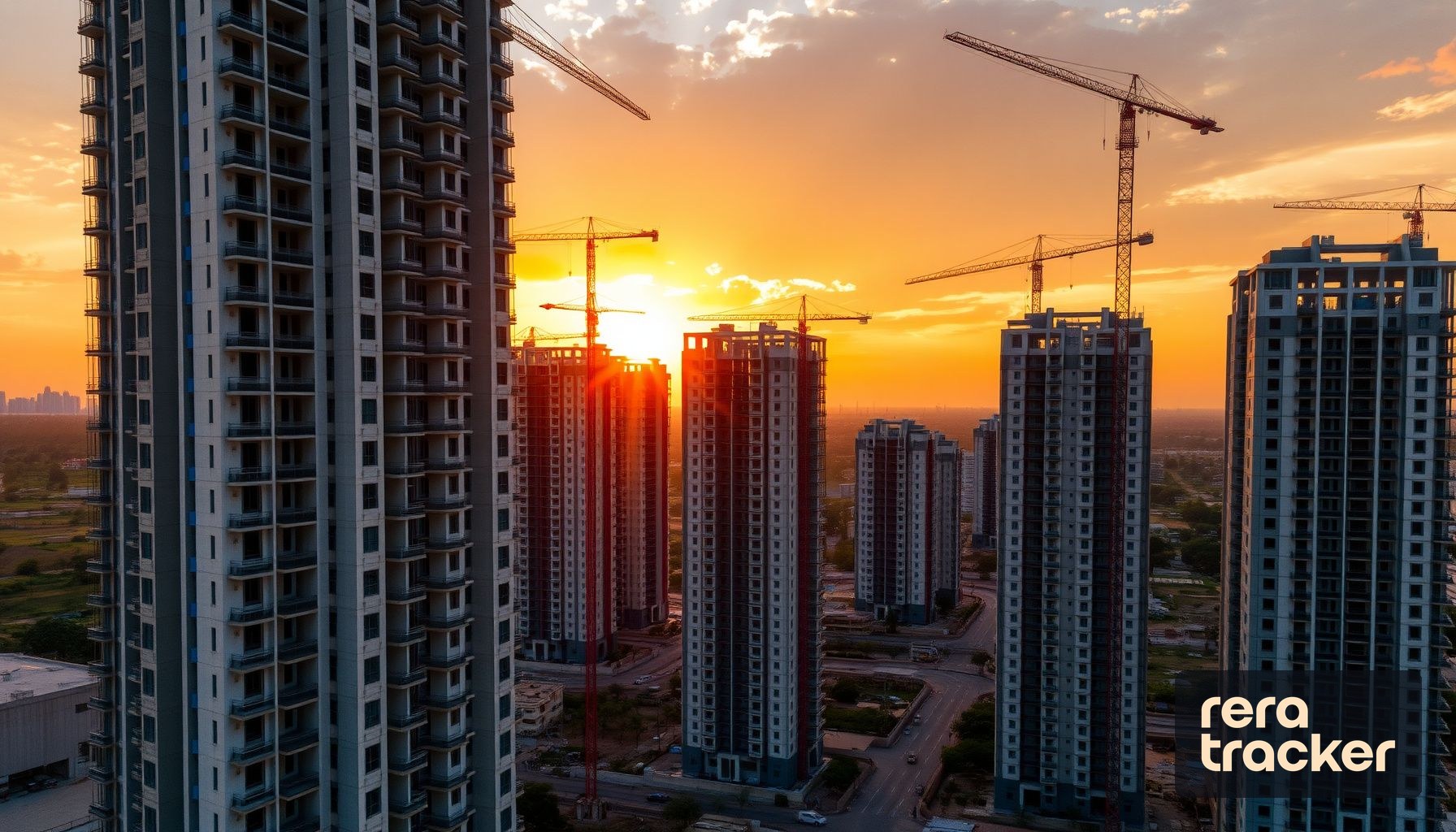
On April 14, 2026, the Economic Times reported that the Washington State Investment Board (WSIB) — one of the largest public pension funds in the United States, managing retirement assets for 17 public employee plans — has committed Rs 230 crore to revive a stalled real estate project in Greater Noida.
The project: Shri Radha Sky Gardens Phase-1, originally developed by SJP Infracon Limited and registered with UP RERA as UPRERAPRJ7482. Launched on 1 March 2013, the project’s official promised completion date was 31 December 2021 — meaning it is now more than four years past its RERA commitment. The 22-acre development houses over 2,000 apartments across roughly 2.4 million square feet of residential space, with a total estimated project cost of Rs 770 crore. The co-developer taking charge of the revival is Hawelia Group, led by Nikhil Hawelia.
Buried in the story is something much bigger. This is WSIB’s first-ever global investment in a stalled real estate project. A US public pension fund — known for conservative underwriting and strict investment criteria — has chosen an Indian stalled-project revival as the place to make that debut.
For the 2,000+ families whose money is stuck in this one project, this is life-changing news. But for every homebuyer in NCR with capital trapped in an incomplete tower, this deal is worth understanding in detail. It is a signal — and possibly a template — for what comes next.
The Project: Shri Radha Sky Gardens, Gautam Buddha Nagar
The project sits on 22 acres in Gautam Buddha Nagar (Greater Noida West / Noida Extension belt), a micro-market that has become the poster child for NCR’s stalled inventory crisis. It was launched in March 2013 by SJP Infracon Limited, sold units to thousands of buyers, and then ran out of capital before completion. The original RERA-committed delivery date of December 2021 came and went without handovers.
The revival numbers:
| Metric | Value |
|---|---|
| RERA registration | UPRERAPRJ7482 |
| Original developer | SJP Infracon Limited |
| Co-developer (revival) | Hawelia Group |
| Launch date | 01 March 2013 |
| Originally promised completion | 31 December 2021 |
| Current delay | 4+ years overdue |
| Total area | 22 acres |
| Residential units | 2,064 flats |
| Buildable area | 2.4 million sq ft |
| Total project cost (estimated) | Rs 770 crore |
| WSIB commitment | Rs 230 crore |
| Expected delivery timeline | 42-48 months from groundbreaking |
You can verify all of this project’s UP RERA data — current registration status, extension filings, and buyer disclosures — on ReraTracker’s project page: Shri Radha Sky Gardens Phase-1.
The revival is structured as a Joint Development Agreement (JDA) between SJP Infracon and Hawelia Group, with WSIB providing construction finance. SJP Infracon remains on the RERA filing while Hawelia steps in as the executing co-developer — the core mechanism of UP’s 2023 Co-Developer Policy.
How the Deal Came Together: A Three-Year Regulatory Chain
This is not an overnight transaction. The regulatory chain that enabled WSIB’s investment stretches back to 2023 and tells you how Indian stalled-project revival actually works today.
2023 (Mid-year): Hawelia Group signed a Memorandum of Understanding with ‘Invest in UP’, proposing a “Co-Developer Policy” that would allow financially healthy developers to step into stalled projects without triggering a full ownership change or buyer consent deadlock.
December 2023: The Uttar Pradesh government formally issued orders adopting the Co-Developer Policy framework. This was the enabling law.
First half of 2024: Greater Noida Authority approved the specific revival proposal for Shri Radha Sky Gardens in its 133rd board meeting. Authority approval is required because most Greater Noida projects sit on leasehold land with pending authority dues.
July 2024: The Joint Development Agreement was executed between the original developer, Hawelia Group, and with consent from homebuyer representatives. This locked in the revival structure.
February 2026: UP RERA approved the revival plan in its 198th board meeting. RERA approval is the final legal unlock — it confirms that the co-developer inherits the project with regulatory clearance and that all existing buyer allotments are honored.
April 2026: WSIB announced its Rs 230 crore commitment.
The three-year timeline is not a bug. It is the mechanism. Stalled project revivals involve layered consent from homebuyers, the authority (for development rights and dues), the original developer, the co-developer, and the regulator. Skipping any layer creates legal risk that institutional capital will not accept.
Why WSIB Chose This Deal (And Why It Matters)
Washington State Investment Board manages approximately USD 200 billion in assets for Washington State’s public employees. Its investment committee has a reputation for disciplined underwriting and a preference for established markets. For WSIB to make its first stalled-project investment in Indian emerging-market real estate — and to do it through a Rs 230 crore commitment — three things had to be true.
One, the regulatory path had to be real. The UP Co-Developer Policy (December 2023) and the subsequent RERA approval (February 2026) gave WSIB a defensible legal structure. Without RERA’s imprimatur, no US public pension would have touched this deal.
Two, the return profile had to be attractive enough to justify emerging-market risk. Construction finance in Indian real estate at the stalled-project level typically targets returns in the high teens to low twenties (IRR), significantly higher than US core real estate. The spread is the compensation for country risk, currency risk, execution risk, and legal risk.
Three, the co-developer had to be credible enough to execute. Hawelia Group has been positioning itself as a revival specialist — its 2023 MoU with Invest in UP was explicitly a pitch to be the executing partner for stalled projects. The deal validates that positioning.
The significance for the broader market is what this signals to other foreign capital. GIC, ADIA, CPPIB, Brookfield, and other sovereign wealth and pension funds watch peers. A single successful deal by WSIB makes it easier for every other foreign institutional investor to write a similar check. Capital follows precedent.
The Bigger Picture: 2 Lakh+ Stalled Flats in NCR Alone
The WSIB deal matters because of the scale of the problem it begins to solve. According to UP cabinet recommendations (based on the Amitabh Kant-led committee), there are more than 200,000 stalled flats across Noida, Greater Noida, and the Yamuna Expressway region alone.
A 2019 PropEquity study — commissioned by the predecessor to SBICAP Ventures’ SWAMIH Fund — estimated roughly 1,500 stalled or stressed projects across India containing 458,000 units and requiring Rs 55,000 crore in completion capital. Those numbers have only grown since.
The NCR crisis is rooted in a specific set of failures that played out between 2012 and 2018. Over-leveraged developers pre-sold thousands of units at aggressive prices, diverted funds across group companies, and ran into liquidity walls when sales slowed. The Amrapali Group saga — which eventually led to Supreme Court takeover and NBCC-led completion — became the signature case. Unitech and Jaypee followed similar trajectories, with Jaypee Wishtown eventually resolved through a Suraksha Realty-led insolvency resolution.
These cases left a generation of NCR homebuyers with the same story: life savings locked in half-built towers, EMIs still running, no delivery date in sight, and courts as the only recourse.
Enter SWAMIH: The Government’s First Attempt at a Solution
Before foreign pension funds arrived, the Indian government built its own revival mechanism. In 2019, the Finance Ministry announced SWAMIH (Special Window for Affordable and Mid-Income Housing) — a Category II Alternative Investment Fund managed by SBICAP Ventures, a subsidiary of State Bank of India.
The numbers, as of late 2025:
| SWAMIH Fund I | Value |
|---|---|
| Total corpus | Rs 15,531 crore |
| Capital fully committed by | December 2025 |
| Projects funded | 145-146 projects |
| Geographic coverage | 30 cities |
| Homes delivered | ~61,000 (across 110 completed projects) |
| Capital unlocked | Rs 37,400 crore across 127 projects |
| Square feet supported | 90+ million sq ft |
| Jobs generated | 36,000+ |
| Expected total delivery | 100,000+ homes |
In February 2025, the Budget announced SWAMIH Fund II with a Rs 15,000 crore target — aimed at another 100,000 units.
SWAMIH has done meaningful work. But a crisis of over 200,000 stalled units in NCR alone, and roughly 458,000 nationwide, cannot be solved with government-backed capital alone. Private and foreign institutional capital must come in to close the gap. The WSIB deal is the first credible sign that foreign capital is starting to show up.
The Legal Mechanism: RERA Section 8 and Co-Developer Policies
For readers who want to understand the exact legal tool being used, it sits in two places.
RERA Section 8 of the Real Estate (Regulation and Development) Act, 2016 allows a Real Estate Regulatory Authority to take over a stalled project and either complete it directly or hand it over to a competent agency with the consent of at least two-thirds of homebuyers by allottee share. This is the backstop — the regulator’s last-resort tool.
State-level Co-Developer Policies (like UP’s 2023 policy) create an earlier, more flexible path. Instead of a takeover, the original developer stays on paper while a financially healthy co-developer brings capital, construction capability, and project management. Homebuyer consent is still required, and RERA approval still anchors the legal structure, but the process is faster than a full Section 8 takeover.
Haryana, Telangana, and Karnataka have signaled interest in similar co-developer frameworks. If WSIB’s deal performs, expect more states to formalize the mechanism.
What This Means for You
If you are a homebuyer with money stuck in a stalled project:
You are not powerless, and you are not first in line. The Amrapali, Jaypee, and Hawelia-WSIB cases prove that stalled projects can be revived — but the process takes years and requires collective action. Organize with other allottees in your project. Form a formal buyer association if one does not exist. Engage with your state RERA authority proactively. Know whether your state has a co-developer policy (UP, Maharashtra, Haryana are moving). Document every payment, every correspondence, and every missed milestone.
The biggest mistake stalled-project buyers make is waiting silently. Projects that get attention get resolved. Projects that do not, do not.
If you are shopping for a property in NCR:
This deal does not change the fundamental rule of buying in Indian real estate today: verify RERA compliance before you pay anything. Every projection in this article — WSIB’s returns, Hawelia’s execution, the 42-48 month timeline — is contingent on the regulatory and construction chain holding. For a new buyer, the lesson is not “stalled projects are investable.” The lesson is that RERA compliance, authority approval, and a clean legal chain are what make a project financeable by serious capital. Look for those signals in the projects you are considering, not just marketing materials.
If you are an investor watching the revival opportunity:
The spread in stalled-project finance is real, but so is the execution risk. Foreign pension funds can absorb it because they have 20-year horizons and professional teams doing due diligence. Retail investors should be extremely cautious about “distressed” real estate schemes from smaller operators promising outsized returns. SWAMIH, SM-REITs focused on completed assets, and direct purchases of RERA-verified projects are cleaner ways to get exposure to Indian real estate.
For a deeper analysis of how to think about real estate as a wealth allocation decision, see our guide on real estate versus mutual funds for Indian investors.
How ReraTracker Tracks the Revival Story
Every stalled project in UPRERA and HRERA jurisdictions is in our database with its original RERA registration, completion deadline, extensions filed, buyer complaints, and current status. When a project enters revival — like Shri Radha Sky Gardens — the updated RERA filing, the JDA details (where public), and the co-developer’s prior track record become part of the project profile on our platform.
For homebuyers in stalled projects: ReraTracker gives you a single page to check the current regulatory status of your project and the historical track record of any co-developer being proposed.
For buyers researching new purchases: you can filter out developers with stalled-project history, compare builder track records across NCR, and verify every RERA commitment before you put money down.
For our broader approach to real estate trust and transparency, see our guide on how to check RERA registration for any Indian project and our Greater Noida RERA project analysis.
The Bottom Line
WSIB’s Rs 230 crore investment is not the largest deal in Indian real estate this year. It is not even the largest foreign institutional commitment to NCR residential. What makes it matter is the category: first foreign pension fund to back a stalled-project revival in India.
The hundreds of thousands of families with capital trapped in NCR’s stalled towers have waited a long time for a signal that their projects are not dead money. This deal is that signal.
But one deal is not a solution. The scale of the problem — 458,000 units nationally, 200,000+ in NCR alone — requires hundreds more transactions like this one. The regulatory infrastructure (RERA Section 8, UP Co-Developer Policy, SWAMIH) now exists. The capital is beginning to show up. The execution question is whether Hawelia and the next co-developers can deliver on the 42-48 month promise.
If they do, Indian stalled-project revival becomes a real asset class. If they do not, WSIB’s deal will be remembered as an experiment that did not generalize.
We will be watching — and reporting — on every milestone. Subscribe to our RSS feed or check our RERA project tracker at reratracker.com to follow the Shri Radha Sky Gardens revival and other stalled-project stories as they unfold.
FAQ
Q: How do I know if my stalled project is eligible for a co-developer revival? A: Check with your state RERA authority for the project’s current status. In UP, the Co-Developer Policy (December 2023) provides a framework. The key requirements are authority clearance, RERA approval, and homebuyer consent. Your buyer association or state RERA’s grievance cell is the right starting point.
Q: Is WSIB the only foreign fund investing in Indian real estate? A: Far from it. GIC (Singapore), ADIA (Abu Dhabi), CPPIB (Canada), and Brookfield have all made large commitments to Indian commercial real estate over the past decade. What makes WSIB’s Hawelia deal different is that it targets a stalled residential project — a category that foreign pension funds have previously avoided.
Q: What happens to my home loan EMI while the project is being revived? A: EMIs continue during the revival period. This is one of the hardest aspects for stuck homebuyers. Some revival negotiations include EMI relief as part of the buyer consent package, but this is not automatic. Speak with your lender and consult a property lawyer familiar with Section 8 cases in your state.
Q: How much return does a foreign fund expect from a stalled-project investment? A: Construction finance in Indian emerging-market real estate typically targets IRRs in the high teens to low twenties — meaningfully higher than US core real estate returns. That spread is the compensation for country, currency, execution, and legal risk.
Q: What is the difference between Section 8 (full takeover) and the UP Co-Developer Policy? A: Section 8 is a RERA-led, last-resort takeover that transfers project control away from the original developer. The Co-Developer Policy keeps the original developer on paper while bringing a capable co-developer in to execute. It is a less adversarial, faster path, but it still requires homebuyer consent and RERA approval.
Q: Will other states adopt similar co-developer policies? A: Signs point to yes. The UP framework is being studied by Haryana, Telangana, and Karnataka. The Amitabh Kant committee recommendations for NCR specifically endorse co-developer mechanisms as a scalable solution to stalled inventory.
Q: Where can I track the Shri Radha Sky Gardens revival progress? A: The UP RERA portal will publish quarterly progress updates as part of the mandatory filings. ReraTracker aggregates those filings for you and flags missed milestones. Bookmark the project page or set up an alert.
This article is analysis based on publicly reported information. We are not legal or financial advisors. Homebuyers in stalled projects should consult qualified property lawyers and RERA-registered practitioners for case-specific advice.
Sources: Economic Times (April 14, 2026), UP RERA 198th board meeting minutes, Greater Noida Authority 133rd board meeting, SBICAP Ventures SWAMIH Fund disclosures, Ministry of Finance Union Budget 2025-26 announcements, PropEquity stalled-projects study (2019).
Intelligence beyond boundaries
12,000+ projects tracked. 5,000+ builders verified. RERA-verified data, fair market insights, and premium intelligence.
Explore ProjectsMore on RERA

RERA Approved Projects in Ghaziabad 2026: Verified Guide for Buyers
Complete 2026 guide to RERA-registered projects in Ghaziabad. UPRERA verification, micro-market analysis across Indirapuram, Raj Nagar Extension, NH-24, and more.

RERA Approved Projects in Greater Noida 2026: Verified List & Buyer's Guide
Complete guide to RERA-registered projects in Greater Noida 2026. Verified UPRERA data, micro-market analysis, builder track records, and what to check before buying.
RERA Approved Projects in Lucknow 2026: Complete Buyer's Guide
Discover RERA-registered projects across Lucknow. UPRERA verification guide, micro-market analysis, top localities, and what every buyer must check before investing.
Stay updated on RERA
Get the latest insights on real estate regulations and compliance delivered to your inbox.
No spam. Unsubscribe anytime.