Khasra Number Explained: What It Is, How to Check, and Why Every Property Buyer in India Must Verify It
Khasra number is the unique survey ID every plot of land in India carries in revenue records. Learn what it means, how to check khasra number online in UP, Haryana, Rajasthan, MP, and other states, and why it's the single most important verification for any land or property transaction.
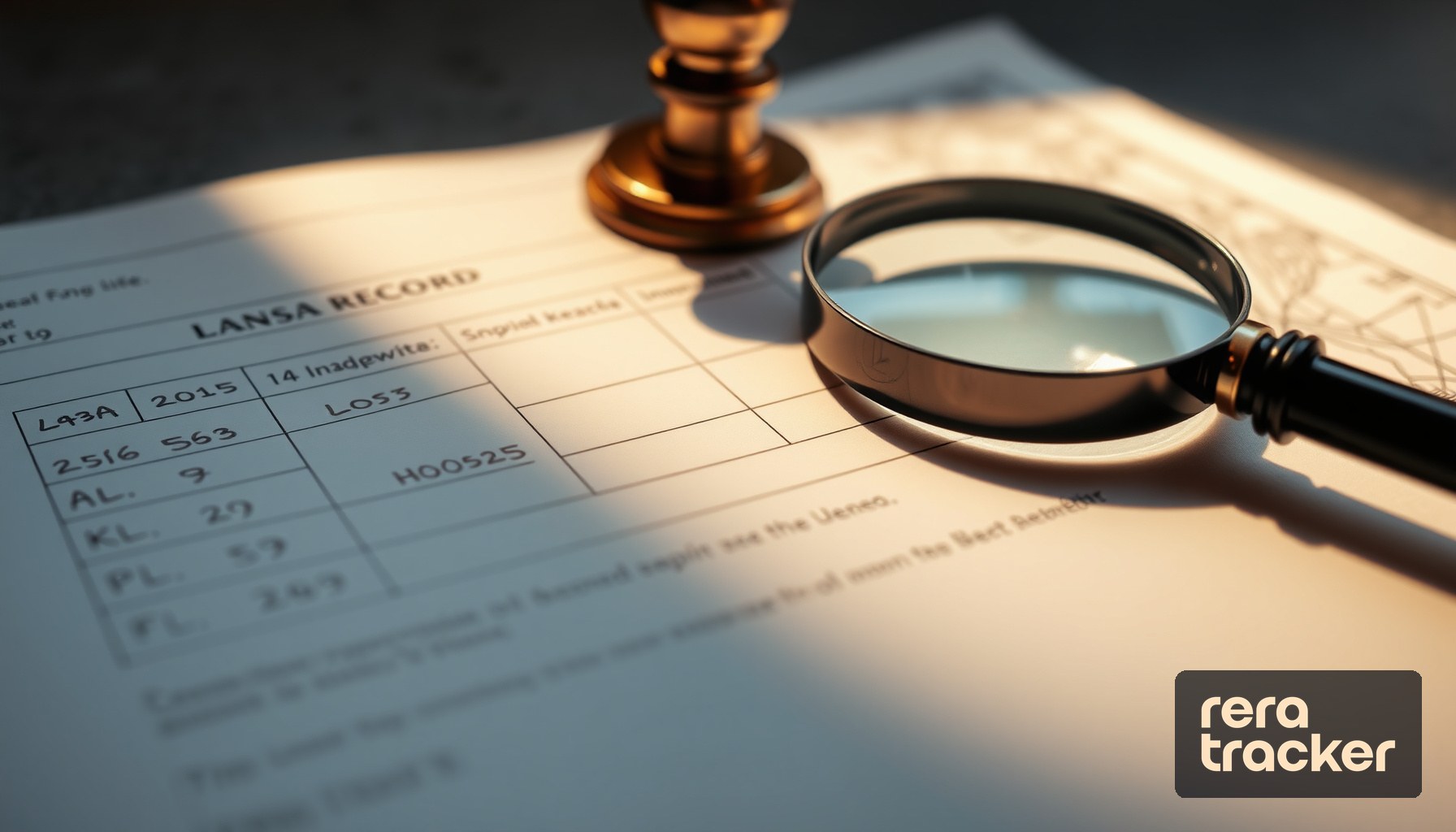
Every plot of land in India carries a unique identifier in the revenue department’s records — the khasra number. If you are buying property, inheriting land, applying for a home loan, verifying a builder’s project claim, or challenging an encroachment, the khasra number is the anchor of every legal and financial conversation that follows.
This guide explains exactly what a khasra number is, how to look it up, how to verify it, and why it matters more than almost any other property document you will encounter.
What Is a Khasra Number?
A khasra number (also called survey number in southern India) is the unique identifier assigned to a specific plot of land during the cadastral survey of a village or revenue area. Every piece of land — agricultural, residential, commercial, government, forest — has one.
The term comes from the Persian / Urdu word for “register”. Each village’s Patwari maintains a khasra register listing every plot in the village, its area, its owner, its classification, and its history of transactions.
In the digital era, khasra numbers are the primary key in every online land-record portal — Bhulekh UP, Bhu Naksha Rajasthan, Apna Khata, E-Dharti, MP Bhulekh, and state-wise equivalents.
What a khasra number is NOT:
- It is not a property address (that’s the postal address)
- It is not a building / flat number (that’s the local authority ID)
- It is not a municipal property tax ID (that’s separate)
- It is not a RERA registration number (that’s the regulator’s ID for projects)
A khasra is a land survey number — the plot-of-earth identifier. Everything else — address, municipal ID, RERA — is layered on top.
Why Every Buyer Must Verify Khasra Before Transacting
The khasra number is the bridge between the ground and the record. Three things a verified khasra proves:
1. The plot exists and is uniquely identified. Without a verified khasra, you have no way to prove which specific plot is being transacted. Boundary disputes, twin-plot fraud, and “this village has five plots with similar names” confusion all collapse when you pin the transaction to a khasra number.
2. The seller’s claimed ownership can be cross-checked. Pull the khatauni for the khasra — if the seller’s name and share match, you are on solid ground. If they don’t match, or the khatauni shows a different owner, the transaction is compromised before it starts.
3. The project’s filed claims can be verified. For RERA-registered projects, the developer files the khasra numbers underlying the project as part of the registration. A buyer can cross-reference the brochure claim, the sale agreement, and the khasra — all three must align.
How to Find a Khasra Number (When You Don’t Already Have One)
Common scenarios and where to look:
| Scenario | Where to find the khasra number |
|---|---|
| Buying an agricultural plot | Seller’s patta / sale deed → mentioned on the deed |
| Buying a resale flat | Original sale deed → usually mentions the khasra under which the project was registered |
| Evaluating a new-launch project | HRERA / UP-RERA filing → “Land Details” section lists khasras |
| Verifying a project on ReraTracker | Project page → “Land Details / Khasra” section |
| Inheriting family land | Village Patwari register / previous mutation orders |
| Searching by owner name | State land portal → search by landholder name → khasra appears |
How to Check Khasra Online — State-Wise
Uttar Pradesh
Portal: upbhulekh.gov.in
Flow: Select District → Tehsil → Village → Search by Khasra Number OR by landholder name → Khatauni displays.
For the cadastral map showing the plot boundary, use bhunaksha.up.nic.in. Full walkthrough: Bhulekh UP Complete Guide 2026.
Haryana
Portal: jamabandi.nic.in (Punjab & Haryana land records — partly integrated)
Flow: District → Tehsil → Village → Enter khasra (Killa Number / Murabba) → Jamabandi appears.
Haryana urban areas also use Killa numbers (rectangular survey units) with Murabba (block) identifiers. A typical Haryana land ID looks like “Killa 17, Murabba 23, Rect 84” — these map to a specific plot.
Rajasthan
Portal: apnakhata.rajasthan.gov.in (jamabandi) and bhunaksha.rajasthan.gov.in (map)
Flow: District → Tehsil → Village → Search khasra → Jamabandi + cadastral map displayed.
Full walkthrough: Bhu Naksha Rajasthan Complete Guide 2026.
Madhya Pradesh
Portal: mpbhulekh.gov.in
Flow: District → Tehsil → Village → Enter khasra number → Nakal (record) displays.
Bihar
Portal: lrc.bih.nic.in (Bihar Land Records & Computerisation)
Flow: District → CO/Tehsil → Mauza (Village) → Enter khata / khasra → Jamabandi displays.
Other States
- Delhi: dlrc.delhi.gov.in — Delhi Land Records
- Maharashtra: mahabhulekh.maharashtra.gov.in — use survey number (called “Gat” or “Serveynumber”)
- Karnataka: landrecords.karnataka.gov.in — survey number based
- Tamil Nadu: eservices.tn.gov.in — patta + chitta records; survey number based
- West Bengal: banglarbhumi.gov.in — dag number (equivalent of khasra)
- Gujarat: anyror.gujarat.gov.in — survey number / block number
Anatomy of a Khasra Record
What you see when you pull a record for a specific khasra:
| Field | Meaning |
|---|---|
| Khasra / Gata Sankhya / Survey No | The plot’s unique ID |
| Khata No | The account grouping this plot under one or more owners |
| Area | Plot size in hectare / square meter (and local units like bigha) |
| Nature of land | Krishi / Abadi / Banjar / Van / Jal (agricultural / residential / barren / forest / water body) |
| Landholder name(s) | Legally recorded owner(s) and share |
| Father’s name + address | Identity confirmation |
| Nature of rights | Bhumidhar / Sirdar / Asami / Bhu Swami / Khatedar — categories differ by state |
| Mutation entries | Every ownership change, dated, with reference to the mutation order |
| Encumbrances | Mortgages, liens, stays — recorded at the tehsil level |
| Government / reservation notes | Any portion acquired, reserved, or under acquisition |
| Last updated | Date of the most recent entry |
Sub-Khasra Numbers: The Detail That Trips Buyers Up
When a plot is divided — through inheritance, partition, sale of a portion, or subdivision for a project — the original khasra gets sub-khasra numbers (like 125/1, 125/2, 125/3). Each sub-khasra is its own legal plot.
Common mistakes:
- A buyer is told “you are buying khasra 125” but is actually being shown khasra 125/2 — check the exact sub-khasra on the portal
- A developer files khasra 125 as project land but only owns khasra 125/1 and 125/3; 125/2 belongs to a third party — verify every sub-khasra the project claims
- An inheritance partition creates new sub-khasras that don’t immediately appear on the portal; if mutation is pending, the older khasra is what’s shown — confirm the partition order
Always ask: “What is the exact sub-khasra number, and is mutation current?”
Cross-Verifying a Khasra for a RERA-Registered Project
Every RERA-registered project must file the underlying khasra numbers with the regulator. Here is the verification flow for a buyer evaluating a new-launch or under-construction project:
- Pull the RERA registration on the state RERA portal (up-rera.in, haryanarera.gov.in, etc.) or on reratracker.com
- Find the “Land Details” section — this lists every khasra the developer has filed as project land
- Pull each khasra on the state land-record portal (upbhulekh.gov.in, apnakhata.rajasthan.gov.in, etc.)
- Verify:
- Owner name matches the developer / holding entity filed with RERA
- Area adds up to the total project land size claimed
- Classification supports the use (residential land for a residential project)
- No active encumbrance that would block the project
If any of these four checks fail, the project has a title or regulatory problem that needs resolution before any payment.
ReraTracker indexes the land details for every state RERA-registered project with the full khasra list under each project page — saving this verification time.
Khasra Verification for Resale / Pre-RERA Properties
For resale flats in older projects, or plot purchases outside RERA’s scope, the khasra verification becomes even more critical — there is no regulator acting as a pre-filter.
Step-by-step:
- Get the khasra from the seller’s sale deed — it’s mentioned on every registered deed
- Pull the current khatauni / jamabandi — verify present owner matches seller
- Trace the mutation chain back — ideally 13+ years, to confirm continuous, unbroken transfers
- Request an Encumbrance Certificate from the Sub-Registrar for the same period
- Visit the plot with a printout of the khatauni + cadastral map — confirm the ground matches the record
- For societies / RWAs: cross-check the khasra against the society’s registered master deed
What a Verified Khasra Does NOT Mean
A clean khasra check is necessary but not sufficient. It does not cover:
- Zoning / master plan — the plot’s land classification on the khasra is revenue; master plan zoning is the local authority’s purview (development authorities, municipal corporations). A khasra-residential plot may still be in a zone that restricts certain constructions.
- Building approvals — khasra proves land; building plan approvals prove construction legality. Check both.
- RERA compliance for projects — RERA is a separate statutory layer; khasra-clean doesn’t mean RERA-compliant.
- Environmental clearances — required for large projects; separate from khasra records.
- Litigation — active lawsuits may not yet reflect on the khasra portal; check court databases.
A complete due diligence combines khasra + zoning + building approvals + RERA + encumbrance certificate + litigation search.
The Minimum Khasra-Driven Verification Every Buyer Should Do
Whether it is a 2-BHK apartment in Noida or a 5-acre agricultural plot in Rajasthan, the khasra verification takes under an hour and costs almost nothing:
- Get the khasra number(s) from the seller / developer
- Pull the khatauni / jamabandi on the state portal
- Pull the cadastral map (Bhu Naksha / equivalent)
- Cross-check area, owner, classification
- Check encumbrances and mutation history
- For RERA projects: cross-reference with the RERA filing and ReraTracker’s project page
- Visit the plot with printouts
The time is measured in hours. The protection is measured in lakhs or crores.
For a state-specific walkthrough, see our Bhulekh UP Complete Guide 2026 and Bhu Naksha Rajasthan Complete Guide 2026. For land unit conversions between bigha, acre, hectare, and square meter, see the Indian Land Unit Converter Guide 2026.
Intelligence beyond boundaries
12,000+ projects tracked. 5,000+ builders verified. RERA-verified data, fair market insights, and premium intelligence.
Explore ProjectsMore on Guides
Mahabhulekh Maharashtra & 7/12 Utara Complete Guide 2026: How to Check Online, Download, and Verify Before Property Purchase
Complete walkthrough of mahabhulekh.maharashtra.gov.in — how to check 7/12 utara, 8A, Fer Far, property card online. Mumbai, Pune, Nashik, Nagpur land record verification step-by-step, and how to cross-check with MahaRERA data.
MP Bhulekh (mpbhulekh.gov.in) Complete Guide 2026: How to Check Madhya Pradesh Land Records, Khasra, Khatauni Online
Step-by-step walkthrough of mpbhulekh.gov.in — MP khasra lookup, khatauni download, Bhu Abhilekh portal, district search across Indore, Bhopal, Gwalior, Jabalpur. Free Naksha download and MP RERA cross-verification.
Stamp Duty & Property Registration Charges in Gurgaon 2026: Complete Breakdown with Circle Rate, Women Rebate & Joint-Ownership
Complete 2026 guide to Gurgaon stamp duty and registration charges — standard rate, women-discount, joint ownership, commercial vs residential, circle rate vs market rate, gift deeds, and how to calculate total transaction cost before booking any property.
Stay updated on RERA
Get the latest insights on real estate regulations and compliance delivered to your inbox.
No spam. Unsubscribe anytime.