Bhulekh UP 2026: Complete Guide to Uttar Pradesh Land Records Online (Khatauni, Khasra, Bhulekh UP Nic In)
Everything you need to check land records online in Uttar Pradesh — step-by-step guide to upbhulekh.gov.in, khatauni downloads, khasra number lookup, Bhu Naksha UP, and what each record means for property verification before you buy.
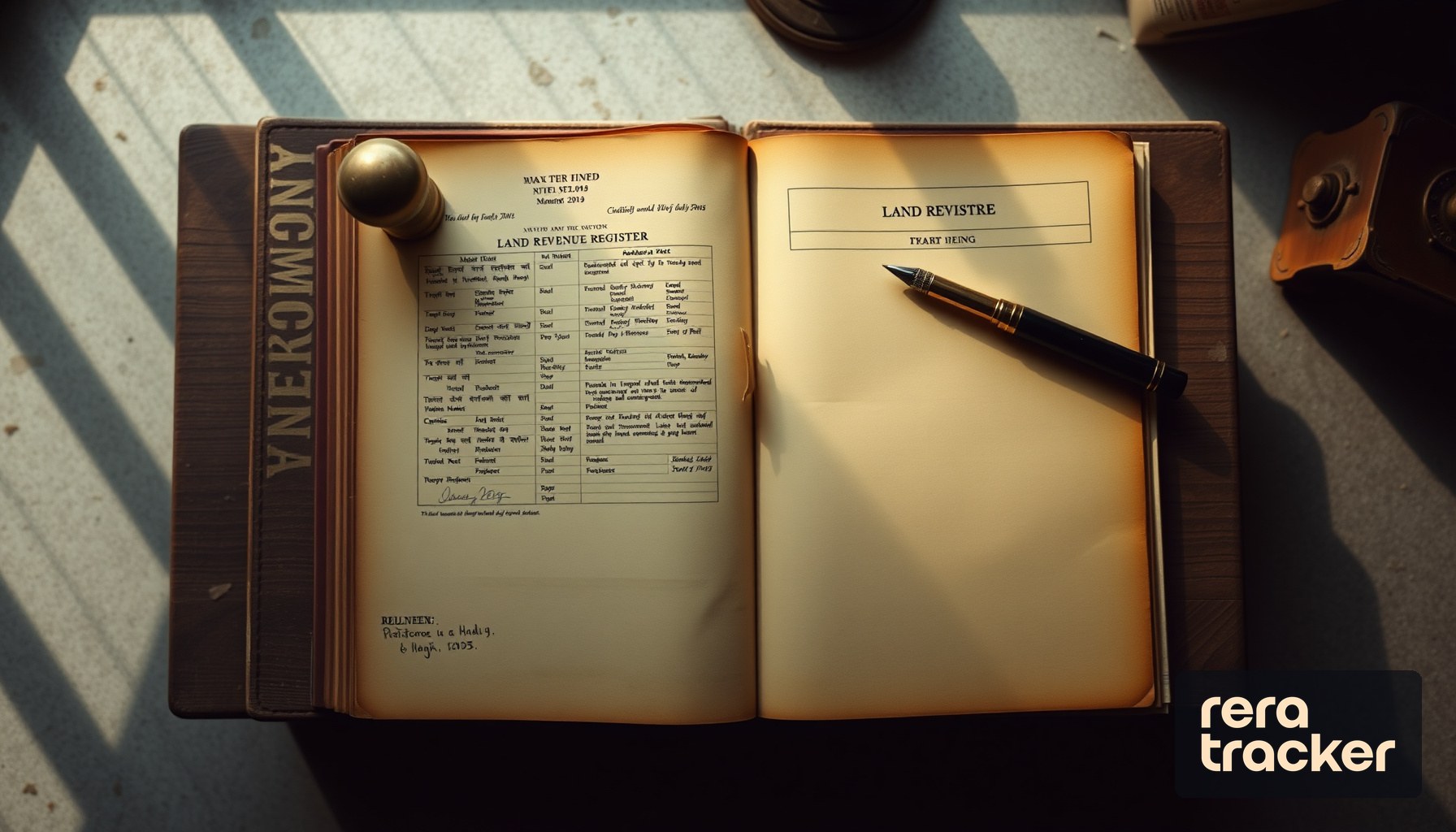
Before anyone pays a rupee for property in Uttar Pradesh, the single most important document to pull is the Bhulekh UP record — the official online land record maintained by the UP Revenue Department. It tells you who actually owns the land, how big the plot really is, whether there are any encumbrances, and whether the record matches what the developer or seller is claiming.
This guide walks through exactly how to check land records online in UP in 2026 — the official portal, the document types, what each record means, and how to cross-verify with RERA data for a complete picture.
What Is Bhulekh UP?
Bhulekh (literally “land writing”) is the digitised land record system operated by state revenue departments across India. In Uttar Pradesh, the official portal is upbhulekh.gov.in, run by the Revenue Council and the Board of Revenue.
The portal centralises three critical record types:
| Record | What it is | When you need it |
|---|---|---|
| Khatauni | The ledger of land rights — who owns which khasra, how much area, nature of rights | Every property transaction; verifying ownership |
| Khasra | A unique survey number assigned to every plot of land in a village | Locating, measuring, and verifying any specific plot |
| Bhu Naksha (Map) | The cadastral map showing plot boundaries and neighbours | Confirming plot location and adjacency; detecting encroachments |
Before the portal went digital (rolled out progressively from 2016), these records existed in physical Patwari registers at the Tehsil level. Getting a copy required multiple visits, fees, and often agent intermediation. Today, most of this is available online, free, within minutes.
How to Check Land Records on upbhulekh.gov.in
The portal supports record lookup by district → tehsil → village → plot identifier. Here is the step-by-step flow:
1. Visit the portal Go to upbhulekh.gov.in. The site is available in English and Hindi — toggle at the top.
2. Select your district Click “Khatauni Ki Nakal Dekhe” (or the English equivalent “Check Khatauni Copy”). You will be asked to select:
- Janpad (District) — e.g. Ghaziabad, Lucknow, Gautam Buddha Nagar
- Tehsil — the sub-division within the district
- Gram (Village / Revenue Village) — the smallest revenue unit
3. Search by one of four identifiers The portal lets you pull a khatauni using any of these:
- Khasra / Gata Sankhya (Plot survey number) — if you know the plot number
- Khata Sankhya (Account number) — if the property is under a specific account
- Khaatedhar Ke Naam Se (By landholder’s name)
- Namantran Dinank Ke Anusaar (By mutation date) — useful for recent transfers
4. Enter CAPTCHA and search Type the security code shown, click search. The khatauni appears on screen.
5. Download the copy The displayed khatauni is view-only. For a certified copy with QR verification (the legally acceptable version), select “Pramaanit Prati” (Certified Copy) and pay the prescribed fee (~Rs 15–30 depending on the number of pages). Payment is online via debit card, UPI, or net banking.
The certified copy with QR is the version to present for bank loan applications, RERA complaints, or legal proceedings.
What’s Actually in a Khatauni?
A typical UP Khatauni document shows:
| Field | What it tells you |
|---|---|
| Village name + code | Revenue village identification |
| Khata number | Account number grouping one or more plots under a single owner |
| Khasra numbers under this khata | Specific plot survey numbers |
| Area (in hectare, or bigha, or square meter) | Recorded plot size |
| Nature of land | Agricultural, abadi (residential), banjar (barren), etc. |
| Landholder name + father/husband name | Legally recorded owner |
| Share | If multiple owners — each owner’s share |
| Nature of rights | Bhumidhar (full rights), Sirdar (limited), Asami (temporary), etc. |
| Encumbrances | Mortgages, liens, court stays, attachments — listed here if any |
| Mutation entries | Every change-of-ownership event, dated |
The encumbrance field is the one most buyers miss. A plot with a standing mortgage, a court stay, or an active litigation note is not safe to purchase even if the seller is presenting clean paperwork separately. Always read the full khatauni, including the footnotes.
Bhu Naksha UP: Checking the Cadastral Map
The khatauni tells you what the record says. The Bhu Naksha shows you where the plot actually is. These often diverge — and that divergence is where buyer problems start.
To check Bhu Naksha UP:
- Visit bhunaksha.up.nic.in
- Select District → Tehsil → Village
- The cadastral map loads with plot boundaries and khasra numbers marked
- Click on any plot to see its khatauni linked inline
- You can download the map PDF with the plot highlighted
Common Bhu Naksha red flags:
- The plot your seller is showing on-ground does not match the recorded khasra boundary
- The plot is shown split across two khasras but the seller claims a single title
- A road, drain, or public utility runs through what the seller claims is the buildable area
- The plot is adjacent to, or partially on, government land marked in a different colour
A physical site visit with the Bhu Naksha printout in hand is non-negotiable for any land purchase. If the seller or broker discourages carrying the map to site, walk away.
Cross-Verifying with RERA Data
For projects under the Real Estate (Regulation and Development) Act 2016 — every UP project with more than eight units or 500 sq m area should be RERA-registered — you can cross-check the Bhulekh UP record against the developer’s UP RERA filing.
This is where ReraTracker indexes become valuable. Every project page on reratracker.com includes a Land Details / Khasra section that lists the khasra numbers the developer has filed with UP RERA. If those khasra numbers do not appear on the seller’s khatauni — or worse, appear under a different name — the filing and the ground reality are misaligned. Do not proceed until this is resolved.
For a step-by-step walkthrough of the RERA verification process itself, see our How to Check RERA Registration in India guide.
Common UP District-Wise Lookup URLs
Each district-tehsil-village path on the portal is dynamic, but the portal is the same:
| District | Use portal | Notes |
|---|---|---|
| Gautam Buddha Nagar (Noida, Greater Noida, Jewar) | upbhulekh.gov.in | High-traffic — include Authority-allotted plots; cross-ref GDA / YEIDA filings |
| Ghaziabad | upbhulekh.gov.in | GDA-allotted projects need cross-ref with GDA authority records |
| Lucknow | upbhulekh.gov.in | LDA-allotted plots cross-verify with LDA filings |
| Agra | upbhulekh.gov.in | ADA-allotted plots cross-verify |
| Jhansi | upbhulekh.gov.in | JDA-allotted plots — many government auction plots fall here |
| Moradabad | upbhulekh.gov.in | MDA / Moradabad Development Authority |
| Gorakhpur | upbhulekh.gov.in | GorakhpurDA Township projects |
| Bareilly | upbhulekh.gov.in | BDA-allotted plots |
| Kanpur | upbhulekh.gov.in | KDA-allotted plots |
| Varanasi | upbhulekh.gov.in | VDA — high circle-rate micro-markets |
What the Bhulekh UP Record Does Not Cover
The portal is authoritative for revenue records. But it does NOT substitute for:
- Title deed chain — the sequence of sale deeds, gift deeds, succession records. Pull these via the Sub-Registrar office or IGRSUP.
- Mutation status — mutation is a separate process after a sale; verify completion at the Tehsil
- Zonal plan / master plan restrictions — zoning is maintained by the local authority (GDA, LDA, Noida Authority etc.)
- RERA compliance for projects — RERA registration is the developer’s statutory obligation, check at up-rera.in and on ReraTracker
- Building plan approval — issued by the local authority, separate from revenue records
- Litigation / pending civil suits — check the Nyaya court database or hire a lawyer for a title search
A complete pre-purchase verification combines: Bhulekh → Bhu Naksha → Sub-Registrar (deed chain) → RERA (if applicable) → Local Authority (zonal compliance).
Encumbrance Certificate: The Missing Piece
For UP, the Encumbrance Certificate (called “Bhaar-Mukti Pramaan Patra” locally) is issued by the Sub-Registrar. It lists every registered transaction affecting the property — sale deeds, mortgages, gifts, partitions, leases — for a period you specify (usually 13 or 30 years).
Request it at IGRSUP (igrsup.gov.in) or at the Sub-Registrar office. Fees are nominal. The EC together with the khatauni gives you a legally complete picture of title and encumbrances.
Why RERA-Registered Projects Simplify This
One of the reasons the UP Real Estate market has become safer for buyers since 2016 is that RERA mandates the developer to file complete land documentation — khasra numbers, title chain, permits, and sanctions — as part of the registration. ReraTracker indexes all of this per project. For a RERA-registered project, the khasra-level verification is largely pre-done by the regulator; you are cross-checking, not hunting.
For pre-RERA projects, plot land purchases, or resale transactions outside RERA’s ambit, Bhulekh UP is your primary verification tool. Use it. Do not skip it.
The Buyer’s Minimum Verification Checklist
Before committing to any UP land or property purchase:
- Pull the khatauni from upbhulekh.gov.in — verify owner name and area
- Pull the Bhu Naksha — confirm plot location matches what the seller shows
- Check encumbrances on the khatauni and request a separate Encumbrance Certificate from the Sub-Registrar
- For projects: verify UP RERA registration at up-rera.in and on reratracker.com
- For the deed chain: request title search from a property lawyer covering at least the last 13 years
- For the zonal status: check the master plan on the local authority’s website
- Carry all printouts to the site visit — the map, the khatauni, the RERA filing
The time and cost of this entire process is modest — typically a few hundred rupees and a day of focused work. The cost of skipping it is measured in lakhs or crores, depending on the property size.
For a complete flat-buying decision framework that goes beyond land records, see our Flat Buying Checklist India 2026. For UP RERA project data indexed with full khasra details, browse reratracker.com.
Intelligence beyond boundaries
12,000+ projects tracked. 5,000+ builders verified. RERA-verified data, fair market insights, and premium intelligence.
Explore ProjectsMore on Guides
Mahabhulekh Maharashtra & 7/12 Utara Complete Guide 2026: How to Check Online, Download, and Verify Before Property Purchase
Complete walkthrough of mahabhulekh.maharashtra.gov.in — how to check 7/12 utara, 8A, Fer Far, property card online. Mumbai, Pune, Nashik, Nagpur land record verification step-by-step, and how to cross-check with MahaRERA data.
MP Bhulekh (mpbhulekh.gov.in) Complete Guide 2026: How to Check Madhya Pradesh Land Records, Khasra, Khatauni Online
Step-by-step walkthrough of mpbhulekh.gov.in — MP khasra lookup, khatauni download, Bhu Abhilekh portal, district search across Indore, Bhopal, Gwalior, Jabalpur. Free Naksha download and MP RERA cross-verification.
Stamp Duty & Property Registration Charges in Gurgaon 2026: Complete Breakdown with Circle Rate, Women Rebate & Joint-Ownership
Complete 2026 guide to Gurgaon stamp duty and registration charges — standard rate, women-discount, joint ownership, commercial vs residential, circle rate vs market rate, gift deeds, and how to calculate total transaction cost before booking any property.
Stay updated on RERA
Get the latest insights on real estate regulations and compliance delivered to your inbox.
No spam. Unsubscribe anytime.