Carpet Area vs Super Built-Up Area: The Complete Guide to What You're Actually Paying For
Understand the difference between carpet area, built-up area, and super built-up area — with calculation methods, RERA rules, and how to avoid paying more than you should.
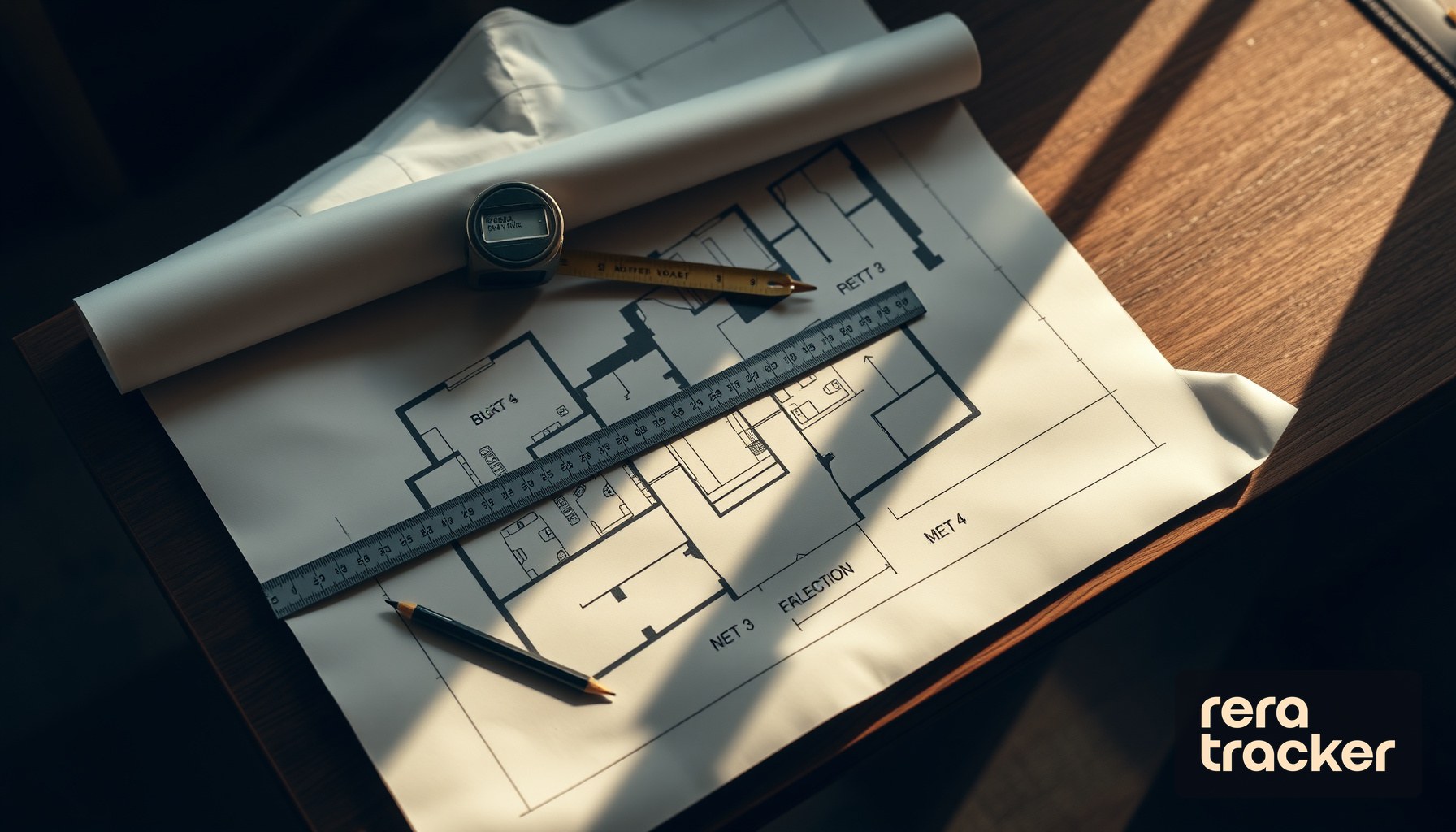
When you buy a flat advertised as “1,500 sq ft,” you might assume that is the space you will live in. It is not. In most cases, the usable area inside your home is 25 to 35 percent smaller than the number on the brochure. The difference comes down to how developers measure and label area — and understanding carpet area vs super built-up area is one of the most important things you can do before signing a purchase agreement.
This guide breaks down what each measurement means, how they relate to each other, what RERA says about it, and how to make sure you are paying for actual living space and not for lobbies, staircases, and walls you share with your neighbours.
Three Types of Area: What Each One Means
Carpet Area
Carpet area is the net usable area inside your apartment — the floor space where you can actually lay a carpet. It includes the area of every room, kitchen, bathroom, and balcony enclosed within the walls of your unit.
What carpet area includes:
- Bedrooms, living room, dining area
- Kitchen and bathrooms
- Store rooms and utility areas
- Internal corridors within your flat
- Enclosed balconies
What carpet area does not include:
- Thickness of internal walls
- Thickness of external walls
- Common areas shared with other residents
This is the space that belongs to you. When you think about how large your home actually is, carpet area is the only honest measurement.
Built-Up Area
Built-up area takes the carpet area and adds the thickness of the internal and external walls of your apartment. It also includes any private terrace, dry balcony, or open balcony attached to your flat.
Built-Up Area = Carpet Area + Wall Thickness + Balcony Area
The wall thickness typically adds 20 to 30 percent on top of the carpet area. So a flat with a carpet area of 1,000 sq ft will usually have a built-up area between 1,200 and 1,300 sq ft. This number is sometimes called the “plinth area.”
Super Built-Up Area
Super built-up area is the number developers prefer to advertise because it is the largest. It starts with the built-up area and adds your proportional share of all common amenities — lobbies, staircases, elevators, clubhouse, swimming pool area, generator room, security cabin, and other shared facilities.
Super Built-Up Area = Built-Up Area + Proportionate Share of Common Areas
A flat with a carpet area of 1,000 sq ft might be quoted as 1,400 to 1,500 sq ft in super built-up terms. The gap between carpet area and super built-up area is called the loading factor, and it can vary significantly from one project to another.
Understanding the Loading Factor
The loading factor represents how much common area is being distributed across each unit. It is expressed as a percentage or a multiplier.
Typical Loading Factors
| Conversion | Multiplier Range | Meaning |
|---|---|---|
| Carpet to Built-Up | 1.2x to 1.3x | Walls add 20-30% |
| Carpet to Super Built-Up | 1.3x to 1.5x | Common areas add another 10-20% |
| Built-Up to Super Built-Up | 1.1x to 1.25x | Common area share on top of built-up |
A loading factor of 1.3x means that for every 1,000 sq ft of carpet area, the developer is quoting 1,300 sq ft of super built-up area. A loading factor of 1.5x — which is not uncommon in projects with large amenity zones — means 500 sq ft of that advertised area is walls, corridors, and shared spaces you cannot furnish or use privately.
Some luxury projects with expansive clubhouses and multiple amenity floors push loading factors even higher, sometimes exceeding 1.5x. When evaluating a project, always ask what the loading factor is and compare it against similar projects in the same area.
What RERA Says: Section 4 and Carpet Area Pricing
The Real Estate (Regulation and Development) Act, 2016 made a decisive intervention on this issue. Under Section 4, read with Section 2(k), developers are legally required to sell residential units on the basis of carpet area.
RERA defines carpet area as the net usable floor area of an apartment, excluding the area covered by the external walls, areas under services shafts, exclusive balcony or verandah area, and exclusive open terrace area. However, it includes the area covered by the internal partition walls of the apartment.
What This Means for Buyers
- The agreement for sale must state the price per square foot based on carpet area
- Any reference to super built-up area as the basis for pricing is a violation of RERA provisions
- The allotment letter and all official documents must mention carpet area
- Developers must clearly disclose the carpet area of each unit type on the RERA portal
This was one of the most buyer-friendly changes brought by RERA. Before the Act came into force, there was no standard definition of carpet area, and developers routinely inflated numbers using super built-up figures that included everything from the swimming pool to the fire escape.
Why Some Developers Still Quote Super Built-Up Area
Despite the RERA mandate, you will still encounter developers and brokers who lead with super built-up area numbers. Here is why it persists:
Marketing advantage. A flat that sounds like 1,500 sq ft attracts more attention than one described as 1,050 sq ft, even though both describe the same apartment. The larger number creates a perception of better value, especially for buyers who do not yet understand the distinction.
Price-per-square-foot optics. When a developer quotes a rate on super built-up area, the per-square-foot price appears lower. A flat priced at Rs 8,000 per sq ft on super built-up area sounds cheaper than the same flat priced at Rs 11,500 per sq ft on carpet area — but the total cost is identical.
Pre-RERA projects. Projects that were launched or substantially marketed before RERA implementation in a particular state may still use older terminology in their brochures, even if the formal agreement complies with RERA.
Brokers and resale market. In the secondary market, sellers and agents frequently use super built-up figures because that is what was mentioned in the original allotment. Always ask for the RERA-registered carpet area when evaluating a resale property.
How to Calculate Carpet Area from Super Built-Up Area
If a developer or broker only gives you the super built-up area, you can estimate the carpet area using the loading factor. Here is the conversion formula:
Carpet Area = Super Built-Up Area / Loading Factor
If the loading factor is not disclosed, use these general estimates:
| Project Type | Typical Loading Factor | Carpet Area from 1,500 sq ft SBA |
|---|---|---|
| Standard apartment (no major amenities) | 1.25 - 1.30 | 1,150 - 1,200 sq ft |
| Mid-segment with clubhouse and pool | 1.30 - 1.40 | 1,070 - 1,150 sq ft |
| Premium with extensive amenities | 1.40 - 1.55 | 970 - 1,070 sq ft |
Worked Example
A developer advertises a 3BHK flat at 1,800 sq ft super built-up area with a rate of Rs 7,500 per sq ft. The project has a clubhouse, pool, and landscaped gardens.
Step 1: Estimate the loading factor. For a project with this level of amenity, a loading factor of 1.40 is reasonable.
Step 2: Calculate carpet area. Carpet Area = 1,800 / 1.40 = approximately 1,286 sq ft
Step 3: Calculate the effective rate on carpet area. Total Cost = 1,800 x Rs 7,500 = Rs 1,35,00,000 Effective Rate = Rs 1,35,00,000 / 1,286 = approximately Rs 10,500 per sq ft on carpet area
Step 4: Compare. That Rs 7,500 per sq ft headline number is actually Rs 10,500 per sq ft on carpet area. When you compare this against another project quoting Rs 9,500 per sq ft on carpet area directly, the second project might actually be cheaper despite the higher stated rate.
This is exactly why carpet area calculation matters. Without it, you cannot make an honest comparison between two properties.
What to Check in Your Agreement
Before signing a purchase agreement, verify the following area-related details:
1. Carpet area is explicitly stated. The agreement must mention carpet area as defined under RERA. If the document only mentions super built-up area, raise this with the developer before signing.
2. Rate is calculated on carpet area. The cost per square foot must be on carpet area basis. Cross-check: multiply the carpet area by the stated rate and confirm it matches the total consideration mentioned in the agreement.
3. Common area charges are separate. Some developers list common area maintenance or proportionate share costs separately. Understand what these cover and how they are calculated.
4. Balcony and terrace areas are disclosed. RERA excludes exclusive balcony and open terrace area from carpet area. These should be mentioned separately in the agreement with their own dimensions.
5. Floor plan matches the numbers. Ask for a dimensioned floor plan and do a rough calculation. Add up the room dimensions to see if they align with the stated carpet area. A significant mismatch is a red flag.
6. RERA registration number is present. Every agreement must reference the project’s RERA registration number. Use this to verify the details on your state RERA portal.
Common Tricks Developers Use
Being aware of these practices can protect you from overpaying or misunderstanding what you are buying.
Inflated loading factors. Some developers apply loading factors of 1.5x or higher by including amenities like jogging tracks, open parks, and utility areas that would not normally be distributed across individual units. Always ask for a breakdown of what constitutes the common area component.
Mixing terminology in brochures. A brochure might say “1,500 sq ft” prominently on the cover and mention “carpet area: 1,050 sq ft” in fine print on page eight. Read every page.
Quoting built-up area as carpet area. This is less common now, but some developers include wall thickness in what they call “carpet area.” Compare the developer’s stated carpet area against the RERA portal listing for the same unit type. The portal figure is the legally binding one.
Different rates for different components. A developer might charge Rs 10,000 per sq ft for carpet area, Rs 5,000 per sq ft for balcony, and Rs 3,000 per sq ft for terrace — and then present an “average” rate that blends all three. Understand each component’s pricing individually.
Floor rise and preferential location charges. These are not area-related tricks, but they add to the effective per-square-foot cost. Factor them in when calculating what you are actually paying per square foot of carpet area.
Vague “approximate area” disclaimers. Some agreements include clauses stating that the final carpet area may vary by up to 3 to 5 percent. Under RERA, if the actual area is less than what was agreed, you are entitled to a proportionate refund. Do not ignore these clauses.
How ReraTracker Helps You Compare on Carpet Area
ReraTracker pulls project data directly from state RERA portals, which means every project listing shows the RERA-registered carpet area — not inflated super built-up numbers. When you search for a project on ReraTracker, you see the carpet area as declared by the developer in their official RERA filings.
This makes it straightforward to compare projects on a like-for-like basis. Instead of trying to reverse-engineer carpet area from different developers’ varying definitions of super built-up area, you get one consistent measurement across all RERA-registered projects.
You can also check a developer’s compliance history, project timelines, and registration status — all of which help you evaluate whether the numbers in a brochure match what has been filed with the regulatory authority.
Final Takeaway
The difference between carpet area and super built-up area is not a technicality. It determines how much livable space you get, how much you actually pay per usable square foot, and whether you are making a fair comparison between projects.
Always insist on carpet area figures. Verify them on the RERA portal. Do your own calculation with the loading factor. And before you sign anything, make sure the agreement prices your home on carpet area — because that is what the law requires, and that is what you will actually live in.
Intelligence beyond boundaries
12,000+ projects tracked. 5,000+ builders verified. RERA-verified data, fair market insights, and premium intelligence.
Explore ProjectsMore on Guides
Mahabhulekh Maharashtra & 7/12 Utara Complete Guide 2026: How to Check Online, Download, and Verify Before Property Purchase
Complete walkthrough of mahabhulekh.maharashtra.gov.in — how to check 7/12 utara, 8A, Fer Far, property card online. Mumbai, Pune, Nashik, Nagpur land record verification step-by-step, and how to cross-check with MahaRERA data.
MP Bhulekh (mpbhulekh.gov.in) Complete Guide 2026: How to Check Madhya Pradesh Land Records, Khasra, Khatauni Online
Step-by-step walkthrough of mpbhulekh.gov.in — MP khasra lookup, khatauni download, Bhu Abhilekh portal, district search across Indore, Bhopal, Gwalior, Jabalpur. Free Naksha download and MP RERA cross-verification.

Stamp Duty & Property Registration Charges in Gurgaon 2026: Complete Breakdown with Circle Rate, Women Rebate & Joint-Ownership
Complete 2026 guide to Gurgaon stamp duty and registration charges — standard rate, women-discount, joint ownership, commercial vs residential, circle rate vs market rate, gift deeds, and how to calculate total transaction cost before booking any property.
Stay updated on RERA
Get the latest insights on real estate regulations and compliance delivered to your inbox.
No spam. Unsubscribe anytime.